Key Educational Initiatives in the Vietnam-Netherlands Partnership: Programs, Goals, and Opportunities
Why Vietnam and the Netherlands Are Natural Education Partners
The Vietnam-Netherlands education partnership is grounded in more than diplomatic goodwill — it reflects a genuine alignment of national priorities. Vietnam's government has made education reform a cornerstone of its economic development strategy, while the Netherlands has built one of Europe's most internationally oriented higher education systems, with institutions actively seeking global partnerships.
Historically, Dutch development cooperation in Southeast Asia has been substantial. The Netherlands was among the first European nations to establish structured bilateral education agreements with Vietnam following normalization of relations, and that foundation has deepened considerably since the early 2000s. Today, the relationship spans vocational training, university exchange, curriculum reform, and institutional capacity building.
There's also a practical dimension: the Dutch education system, particularly its HBO (applied sciences) model, produces graduates who are job-ready in technical and agricultural fields — sectors critical to Vietnam's continued economic growth. That overlap in need and supply is what makes this partnership genuinely productive rather than purely ceremonial.
Overview of the Vietnam-Netherlands Education Partnership Framework
The formal structure of this bilateral cooperation rests on a series of memoranda of understanding between the Vietnamese Ministry of Education and Training (MOET) and Dutch governmental and institutional counterparts. These agreements set the terms for student mobility, joint research, and curriculum co-development.
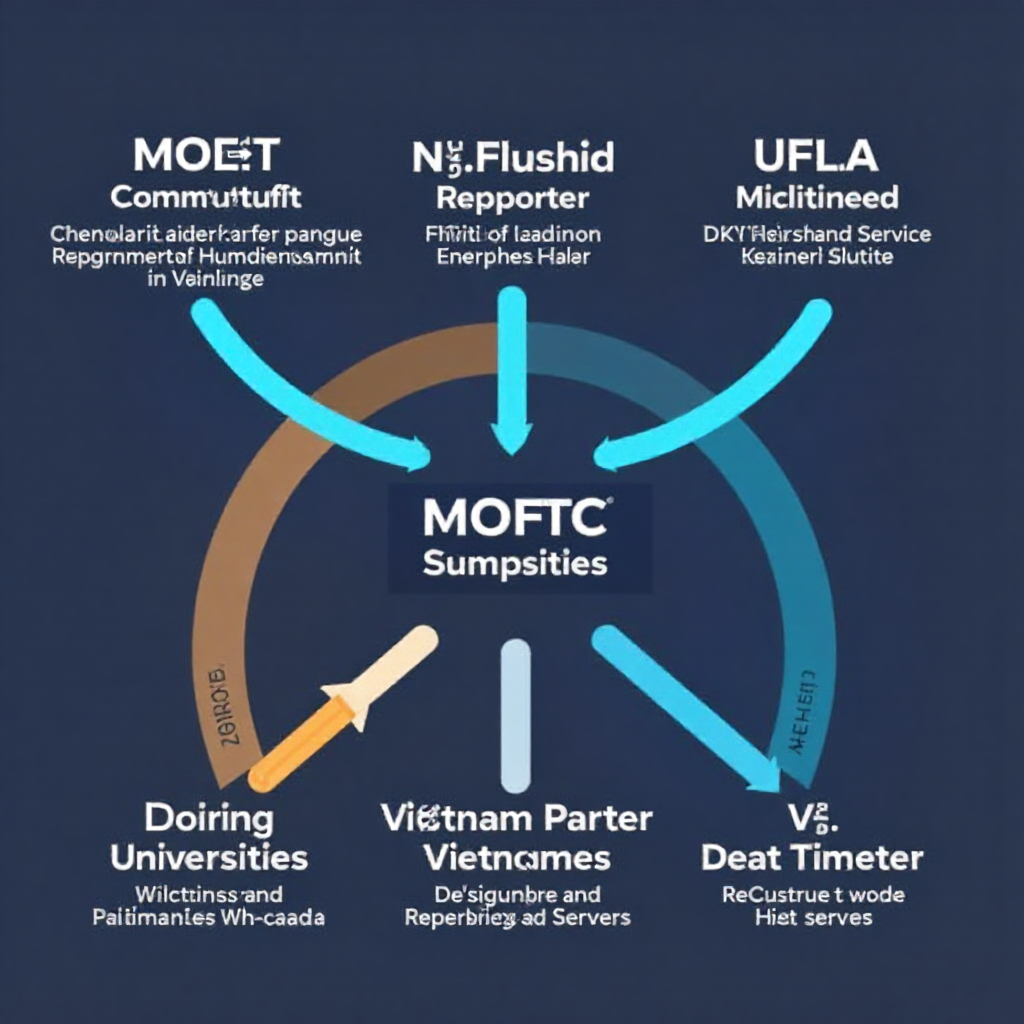
Key institutional actors include NUFFIC, the Netherlands organisation for internationalisation in education, which serves as the operational backbone for many exchange and scholarship mechanisms. On the Vietnamese side, MOET coordinates with provincial education departments and individual universities to implement agreed programs. Dutch universities — both research universities (WO) and universities of applied sciences (HBO) — participate directly through faculty partnerships and joint degree arrangements.
Public-private partnerships also play a meaningful role. Dutch companies operating in Vietnam, particularly in agriculture, water management, and logistics, have co-funded training programs that align with their workforce development needs. This creates a triangular structure: government policy sets the framework, educational institutions deliver the programs, and private sector partners provide both funding and real-world application contexts.
Vocational Education and Training (VET): A Cornerstone of Collaboration
Vocational Education and Training has emerged as perhaps the most strategically significant area of cooperation. The Netherlands holds a globally respected VET system, characterized by strong employer involvement, competency-based curricula, and clear pathways between vocational and higher education. Vietnam, by contrast, has historically undervalued vocational pathways, with students and families preferring university routes even when labor market demand points elsewhere.
Dutch VET expertise has been channeled into Vietnam through several mechanisms. Curriculum development projects have helped Vietnamese vocational schools adopt competency frameworks that align with international labor standards. Teacher training programs have sent Vietnamese VET instructors to the Netherlands for professional development, and Dutch trainers have worked in-country to demonstrate applied pedagogical methods.
The relevance is direct: Vietnam's manufacturing sector, its expanding agri-food industry, and its growing logistics infrastructure all require technically skilled workers at the mid-level — precisely the graduates a well-functioning VET system produces. Choosing VET reform as a priority area means accepting a longer timeline for cultural shift, but the structural payoff is significant.
Higher Education Exchange and Joint Degree Programs
At the university level, the partnership has generated student mobility flows and joint academic programs that benefit both countries. Vietnamese students studying at Dutch institutions bring tuition revenue and international diversity; Dutch universities gain access to a large, motivated student population with strong STEM backgrounds.
Joint degree programs — where students earn qualifications recognized by both Vietnamese and Dutch institutions — represent the most intensive form of academic cooperation. These programs typically involve a period of study in Vietnam followed by one or two semesters at a Dutch partner university, culminating in a dual credential. Fields like water management, agri-technology, and business administration have seen the most activity here.
Student exchange at the undergraduate and postgraduate levels is facilitated by bilateral agreements between specific institutions. Wageningen University, for instance, has maintained long-standing ties with Vietnamese agricultural universities, reflecting the Netherlands' global leadership in food and agricultural sciences. Similarly, TU Delft has engaged Vietnamese engineering faculties in collaborative research.
Scholarships and Funding Pathways for Vietnamese Learners
Financial support mechanisms make the partnership accessible to students beyond elite institutions. The Orange Tulip Scholarship (OTS) is the most prominent funding pathway for Vietnamese students seeking to study in the Netherlands. Administered through NUFFIC and the Dutch Embassy in Hanoi, the OTS covers partial or full tuition at participating Dutch universities, with recipients selected on academic merit and motivation.
The application process requires Vietnamese students to first gain admission to an eligible Dutch institution, then apply for the scholarship through that institution's OTS allocation. Competition is real — the number of scholarships available each year is limited, and strong academic records plus clear professional development goals are essential components of a competitive application.
Beyond OTS, Vietnamese students can access funding through the NUFFIC-administered Holland Scholarship, institutional grants from individual Dutch universities, and sector-specific funding linked to development cooperation projects. Government-sponsored Vietnamese students also participate through MOET's 322 and 911 scholarship programs, which have historically included the Netherlands as a priority destination country.
The Role of Consulting and Bridge Projects in Driving Reform
Policy agreements and scholarship programs are necessary but not sufficient. The gap between bilateral frameworks and actual classroom change is where consulting and bridge projects do their most important work. These initiatives translate high-level commitments into operational reality — curriculum documents become teaching materials, quality assurance frameworks become inspection procedures, and institutional partnerships become functioning exchange pipelines.
Bridge projects typically involve a consulting team with expertise in both Dutch educational standards and Vietnamese institutional contexts. They work alongside MOET officials, university administrators, and VET school leaders to identify gaps, design interventions, and build local capacity so that improvements persist after the project concludes. This is a critical distinction from one-off training events: effective bridge projects aim for institutional embedding, not just individual skill transfer.
Quality assurance alignment is one concrete example of this work. Dutch higher education operates under the Accreditation Organisation of the Netherlands and Flanders (NVAO) framework. Bridge projects have helped Vietnamese institutions understand and move toward comparable standards, which in turn makes joint degree programs credible and joint research publishable in international venues.
For Vietnamese educators or administrators considering engagement, the entry point is often through NUFFIC's country programs or through Dutch Embassy-supported project calls. Institutions that have already established a relationship with a Dutch partner university are better positioned to participate in funded consulting frameworks.
Outcomes, Challenges, and the Road Ahead
The Vietnam-Netherlands education partnership has produced measurable results: thousands of Vietnamese students have studied in the Netherlands over the past two decades, dozens of VET institutions have updated their curricula with Dutch input, and a cohort of Vietnamese educators has direct experience with Dutch pedagogical methods. These are real gains.
The challenges are equally real. Sustainability is a persistent concern — when project funding ends, institutional momentum can stall without committed local champions. Language barriers limit the depth of curriculum integration, since most Dutch-language academic resources require translation or adaptation for Vietnamese contexts. And the mismatch between Vietnamese credential recognition frameworks and Dutch qualification structures creates friction for returning graduates trying to leverage their Dutch education in the Vietnamese labor market.
Looking ahead, the partnership is likely to deepen in areas where both countries face shared challenges: climate adaptation (water management, delta agriculture), digital skills development, and healthcare workforce training. These are domains where Dutch expertise is globally recognized and Vietnamese demand is structurally growing.
The most durable progress will come from building Vietnamese institutional capacity rather than creating dependency on external expertise. That means training Vietnamese curriculum developers, not just delivering Dutch curricula. It means mentoring Vietnamese quality assurance officers, not just applying Dutch standards. The bridge project model, at its best, is designed precisely with that distinction in mind.
Frequently Asked Questions
What types of Vietnamese institutions are eligible to participate in Netherlands partnership programs?
Both universities and vocational schools can participate, depending on the program. University-level cooperation typically involves institutions under MOET's direct management or key national universities. VET programs often target provincial vocational colleges identified as reform priorities. Eligibility is usually defined in the specific project or agreement documentation.
How does the Orange Tulip Scholarship work for Vietnamese students?
Vietnamese students must first receive an offer of admission from a participating Dutch institution. They then apply for the OTS through that institution during a defined application window, typically between January and April for the following academic year. Each Dutch institution manages its own OTS allocation, so requirements and deadlines vary slightly.
What is the role of NUFFIC in the Vietnam-Netherlands education partnership?
NUFFIC serves as the Netherlands' primary agency for education internationalisation. In the context of Vietnam, it administers scholarship programs, supports institutional partnerships, and provides information services for Vietnamese students and institutions. NUFFIC's country offices and partner networks also facilitate project development between Dutch and Vietnamese educational institutions.
How can Vietnamese educators or administrators get involved in capacity-building programs?
The most direct routes are through MOET-coordinated programs, Dutch Embassy project calls in Hanoi, or through existing institutional partnerships with Dutch universities. Educators can also follow NUFFIC's announcements for short-course and professional development opportunities specifically designed for education professionals from partner countries.
What makes the Dutch VET model relevant to Vietnam's education reform goals?
The Dutch VET system is built around employer co-design, competency-based assessment, and clear articulation pathways to higher education. Vietnam's reform agenda explicitly targets these same features — reducing credential inflation, improving graduate employability, and building stronger links between education providers and industry. The Dutch model offers a working example of how these goals can be institutionalized, which is more useful than abstract policy frameworks.