The Impact of Dutch Consulting on Vietnam’s Agricultural Sector
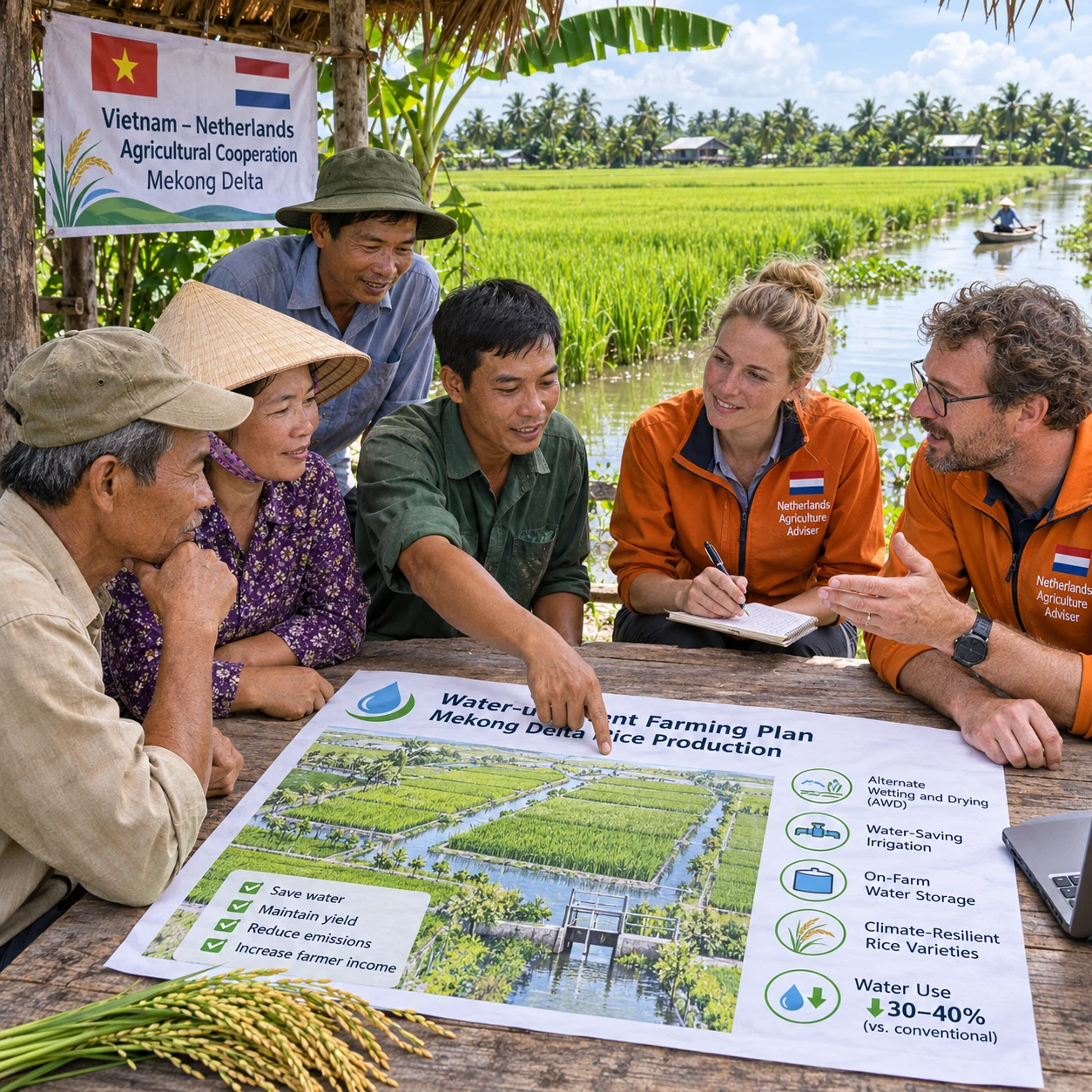
Dutch consulting can contribute expertise, planning methods, and practical knowledge exchange to Vietnam’s agricultural sector. Its impact depends on how well cooperation programs respond to Vietnamese priorities, work with local institutions and farmer organizations, and support solutions that communities can maintain over time.
Why Dutch–Vietnamese agricultural cooperation matters
Dutch–Vietnamese agricultural cooperation matters because both countries have strong reasons to improve water management, sustainable production, and the resilience of agricultural livelihoods. Dutch agricultural consulting can bring relevant technical experience, while Vietnamese researchers, public agencies, businesses, and farmers provide essential knowledge of local conditions and development priorities.
Vietnam’s agriculture spans varied landscapes and production systems, from the Mekong Delta’s rice and aquaculture to coffee in the Central Highlands and horticulture near urban markets. Climate risks, changing water availability, soil pressures, and market demands affect regions differently. A solution suited to one crop or province may not work elsewhere.
International cooperation programs are most useful when they treat this diversity as a starting point. Dutch and Vietnamese partners can jointly identify problems, test approaches, and adapt plans with local stakeholders. That is different from simply transferring a model developed in another country. The goal is two-way knowledge exchange: Vietnamese partners shape the agenda, and Dutch advisers contribute methods or technical perspectives where they add value.
Cooperation also needs realistic expectations. Advisory work can help improve planning or strengthen institutions, but it cannot by itself resolve constraints such as limited investment, fragmented supply chains, or unequal access to services. Its contribution is strongest when linked to local capacity, financing, and decisions made by Vietnamese organizations.
Areas where Dutch expertise can contribute
Dutch expertise can contribute to Vietnam’s agriculture in water management, climate-resilient production, and agricultural value-chain development. The right focus depends on local needs, available resources, and the capacity of Vietnamese partners to test and sustain proposed changes.
Water management and climate resilience
Water management is a natural area for exchange, particularly where agricultural production must respond to floods, drought, salinity, or competing demands for water. Consulting may support basin and irrigation planning, water-use assessments, drainage strategies, or coordination between agencies and farming communities. In the Mekong Delta, for example, planning should account for local cropping choices, salinity patterns, infrastructure, and the needs of households that depend on farming and aquaculture.
Climate resilience is not a single technology. It can involve adjusting planting schedules, improving access to climate information, choosing suitable crop varieties, or planning infrastructure with future risks in mind. Each option has trade-offs: an investment that reduces exposure to one hazard may be costly or less useful under another scenario. Local data and farmer experience should guide decisions.
Sustainable production and value chains
Dutch agricultural consulting may also support sustainable agriculture through soil and nutrient management, efficient water use, integrated pest management, and better farm-level planning. Advice needs to fit the crop, labor availability, input costs, and local knowledge. A technically sound practice is unlikely to last if farmers cannot afford it or see a clear benefit.
Work on agricultural value chains can connect production decisions with post-harvest handling, storage, processing, quality standards, and market information. Consulting may help partners identify where produce loses quality or where requirements from buyers create barriers for smallholders. Stronger coordination can improve market access, though meeting standards may require training, equipment, and reliable purchasing relationships.
Vietnamese universities, research institutes, agricultural extension services, cooperatives, and farmer organizations can help shape and evaluate these efforts. Their involvement keeps recommendations grounded in the institutions and production systems expected to use them.
How consulting translates into practical support
Dutch agricultural consulting translates into practical support when advisers work with Vietnamese partners to diagnose needs, test options, build skills, and strengthen institutions. A report alone rarely changes farming practice; implementation requires local ownership, follow-up, and resources.
A cooperation program might begin with a joint assessment: which farmers face the problem, what they already do, and what prevents improvement? Partners can then agree on a limited set of actions, such as piloting water-saving methods, improving farm records, or revising an irrigation plan. Monitoring should track both intended results and unintended effects, including added labor, costs, or unequal access.
Knowledge transfer can take several forms:
- Applied research: Vietnamese and Dutch specialists compare practices, test options under local conditions, and share findings in usable formats.
- Training and extension: Advisers prepare local trainers and extension workers, who can continue supporting farmers after a program ends.
- Planning and institutional support: Technical teams help agencies and farmer organizations coordinate decisions, use evidence, and plan investments.
- Peer learning: Farmers, cooperatives, and businesses exchange practical experience, including what did not work and why.
Effective projects make responsibilities explicit. Who maintains equipment? Who pays for inputs after a pilot? Which organization collects and shares data? Clear answers matter as much as the original technical design. Cooperation should strengthen Vietnamese capacity to make and adapt decisions, rather than leave partners dependent on outside advisers.
Potential benefits for farmers and the sector
Dutch consulting could help farmers and Vietnam’s agricultural sector improve productivity, climate resilience, market access, and resource efficiency. These are potential outcomes, not guaranteed results; they depend on adoption, affordability, and sustained support.
For a farmer, the value of advice is concrete. It may mean using water more carefully, reducing avoidable input costs, protecting crop quality after harvest, or receiving clearer information about buyer requirements. For a farmer organization, it might mean coordinating training, negotiating with suppliers, or helping members meet a shared quality standard.
At sector level, cooperation can help institutions coordinate water and land-use planning, connect research with extension services, and build stronger links between producers and markets. Better coordination may reduce duplication and help public or donor investment target practical bottlenecks. But productivity gains should not be judged only by output. Programs should also consider household income, labor demands, resource use, and whether smaller producers can participate.
A useful way to assess impact is to follow a three-part test: Does the practice work locally? Can farmers afford and maintain it? Can local organizations continue supporting it? If any answer is no, the proposed benefit may remain limited to a short pilot or a small group of participants.
Challenges to effective cooperation
The main challenges are ensuring local fit, making adoption affordable, coordinating institutions, and sustaining capacity after external support ends. Addressing these issues early helps prevent a technically promising program from producing little lasting change.
- Importing solutions without adaptation: A method developed for different soils, water systems, or farm sizes may not transfer directly. Test it with local producers and revise it before wider use.
- Underestimating costs: Farmers may face new expenses for equipment, labor, certification, or inputs. Include a realistic cost assessment and explore financing or lower-cost alternatives.
- Weak coordination: Ministries, provinces, research bodies, businesses, and farmer organizations may have overlapping roles. Agree on decision rights, timelines, and data-sharing responsibilities.
- Ending support too soon: A short project can deliver training without building the local staff and budgets needed to continue it. Plan for follow-up, trainer development, and maintenance from the start.
There is also a risk of measuring success by activities completed, such as workshops held or reports delivered, rather than by useful changes. Programs should define practical indicators with Vietnamese partners and check who benefits. If women, smallholders, or remote communities cannot access the service, the project’s sector-wide claims need to be limited.
What stronger cooperation could look like
Stronger Dutch–Vietnamese cooperation would begin with locally led priorities and pair technical advice with long-term capacity-building. It would make room for testing, revision, and honest evaluation rather than promising that one model will fit every region.
In practice, partners could agree on a small number of shared objectives, select pilot locations with relevant farmer organizations, and set a baseline before activities begin. They could then review results at agreed intervals, including costs and adoption barriers, and decide together whether to adapt, expand, or stop an approach. This learning cycle keeps investment tied to evidence and local judgment.
Programs should also connect agricultural advice with the systems that make it usable: extension services, research institutions, local government planning, finance, and private-sector buyers. Dutch advisers can contribute specialized expertise, but Vietnamese partners should lead decisions about priorities and implementation. Farmer organizations need a meaningful role in both design and evaluation, not only in recruiting participants.
The long-term measure of impact is whether Vietnamese institutions and farming communities can keep improving practices after a cooperation program closes. When knowledge exchange, water management, sustainable production, and value-chain development reinforce one another, international cooperation can support a more resilient and competitive agricultural sector without overstating what consulting alone can achieve.